🔊 QCM & QCM-D
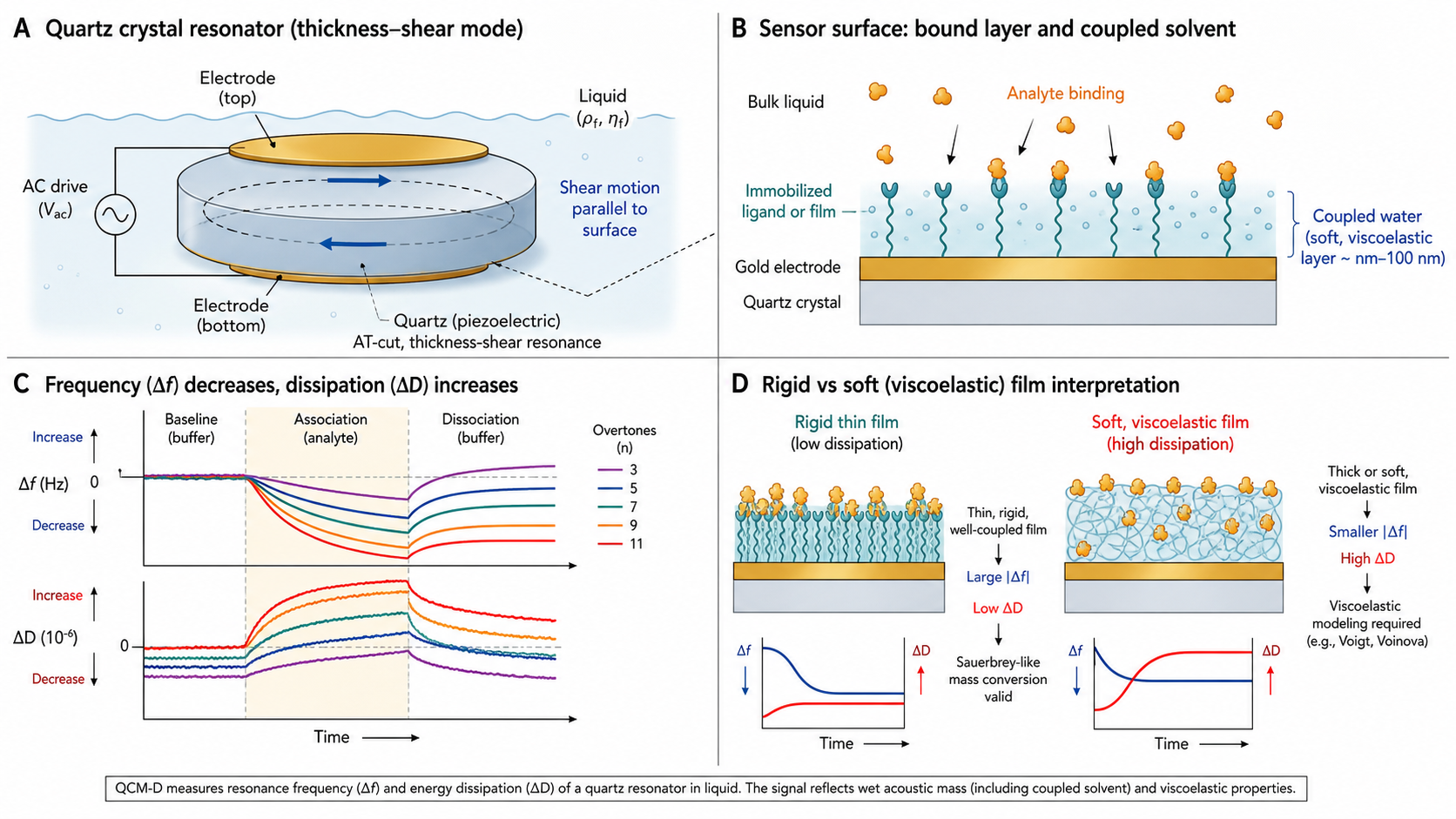
Quartz Crystal Microbalance (QCM) exploits the piezoelectric effect in quartz — applying an alternating voltage across a thin AT-cut quartz crystal disk induces thickness-shear mode oscillations at a fundamental frequency of typically 5 MHz. When mass adsorbs onto the crystal surface, the resonance frequency decreases according to the Sauerbrey equation. Unlike optical biosensors (SPR, BLI, GCI) that detect refractive index changes, QCM measures inertial mass directly — including hydrodynamically coupled solvent trapped within and around the adsorbed layer.
Adding dissipation monitoring (QCM-D) reveals the viscoelastic properties of the adsorbed film, distinguishing rigid protein monolayers from soft, hydrated polymer brushes. By measuring frequency shift and energy dissipation at multiple overtones simultaneously, QCM-D provides a rich, multi-parameter dataset that no single optical technique can match.
Acoustic mass sensing
Measures wet mass — molecules plus coupled solvent. Typically 1.5–3× the dry mass for protein films.
Viscoelastic profiling
Dissipation monitoring reveals film softness, hydration, and structural changes in real time.
Multi-overtone analysis
Up to 7 harmonics probe different depths into the film, revealing layer structure and rigidity.
Label-free & real-time
No fluorescent tags or labels needed. Monitor adsorption, binding, and conformational changes as they happen.
Absolute quantification
Sauerbrey equation gives mass in ng/cm² from first principles — no calibration standards needed for rigid films.
Key Physics Concepts
⚡ Piezoelectric Effect
Quartz crystals convert electrical energy to mechanical oscillation and vice versa (Curie brothers, 1880). The AT-cut (a singly-rotated Y-cut, ~35°15' rotated about the X axis from the Z (optic) axis) produces thickness-shear vibrations with a near-zero temperature coefficient at ~25°C.
The shear wave penetrates ~250 nm into aqueous solution at 5 MHz, making QCM inherently surface-sensitive. The penetration depth scales as 1/√f — higher frequency crystals probe thinner layers.
📐 Sauerbrey Equation
where C ≈ 56.6 Hz·cm²/μg for a 5 MHz crystal. Valid only when the adsorbed film is rigid, uniformly distributed, and thin (Δf/f₀ < 2%).
For liquid operation, the Kanazawa-Gordon equation adds a viscosity-density term for bulk liquid coupling. Sensitivity scales as f₀² — higher-frequency crystals give more Hz per ng of mass.
🌊 Dissipation & Viscoelasticity
Dissipation measures energy loss per oscillation cycle. D ≈ 0 for rigid films (Sauerbrey valid); D ≫ 0 for soft, viscoelastic layers.
Rule of thumb: if ΔD/(−Δf/n) > ~4 × 10⁻⁷ Hz⁻¹ (≈ 0.4 × 10⁻⁶ Hz⁻¹; Reviakine 2011, from ΔD₁/Δf₁ ≈ 2/f₀ for a 5 MHz crystal), the layer is viscoelastic. Examples of soft films: polymer brushes, hydrogels, DNA films, lipid vesicles before rupture, cell layers.
Voigt Viscoelastic Model
When the Sauerbrey equation breaks down (significant dissipation), the adsorbed layer is modeled as a Kelvin-Voigt element: a spring (shear storage modulus μf) in parallel with a dashpot (shear viscosity ηf). By fitting Δf and ΔD at multiple overtones simultaneously, the Voigt model extracts:
Film thickness df — the "acoustic thickness" including coupled solvent
Film density ρf — often assumed (~1050–1200 kg/m³ for biomolecular films)
Shear storage modulus μf — film elasticity (stiffness)
Shear viscosity ηf — film viscosity, the dashpot parameter (energy dissipation; loss modulus G″ = ω·ηf, with ω = 2π·n·f0)
Overtone Analysis
A QCM crystal oscillates at its fundamental frequency and at odd harmonics (n = 1, 3, 5, 7, 9, 11, 13). For a 5 MHz crystal, the 3rd overtone is 15 MHz and the 13th overtone is 65 MHz. Data is conventionally plotted as Δf/n (normalized frequency shift) vs time for each overtone.
Overtones overlay → Rigid film
When all overtones give the same Δf/n, the adsorbed layer is rigidly coupled to the crystal surface. The Sauerbrey equation applies directly. Typical examples: dense protein monolayers, self-assembled monolayers (SAMs), metal oxide films.
Overtones spread → Viscoelastic film
When |Δf/n| varies with overtone number, the film is viscoelastic. Higher overtones have shorter penetration depths (δ = √(η / (π · n · f₀ · ρ))), probing closer to the surface. This provides depth-dependent structural information. Examples: polymer brushes, lipid vesicles before rupture, loosely bound DNA layers.
Note: The fundamental (n=1) is typically not reported in liquid QCM-D because it is strongly influenced by crystal mounting and clamping. The 3rd or 5th overtone is usually the lowest reliable overtone.
Interactive QCM-D Simulator
Explore acoustic biosensing: frequency shifts, dissipation, and overtone analysis
QCM-D Sensorgram Simulator
Simulate a binding event and observe how frequency shift (Δf/n) and dissipation (ΔD) respond across overtones. Toggle film rigidity to see overtone spreading in soft films.
Frequency Shift (Δf/n)
Dissipation (ΔD × 10⁻⁶)
Common Applications
🧬 Biomolecular Adsorption
Protein adsorption and denaturation on surfaces, supported lipid bilayer formation (vesicle adsorption → rupture → spreading), DNA hybridization, and polymer brush characterization. QCM-D uniquely reveals hydration and structural changes during these processes.
💊 Drug Discovery
Cell-surface interactions (living cells on QCM sensors), membrane-drug binding, biofilm formation and disruption, nanoparticle-surface interactions. Attana's Cell 250 (successor to the Cell 200) enables QCM with living cells for more physiologically relevant binding studies.
🔬 Materials Science
Thin film deposition monitoring (PVD, CVD, ALD), corrosion studies (electrochemical QCM), battery electrode characterization, polymer film swelling and cross-linking, surface coating quality control.
Instruments using QCM-D
Biolin Scientific (QSense) — QSense Analyzer, Explorer, Pro, Omni; ring-down QCM-D, up to 7 overtones, 4–8 channels. The original QCM-D platform and still the most widely used in academic research.
AWSensors — X1, X4; high-frequency fundamental (HFF-QCM) up to 50–150 MHz, also supports Love-wave SAW sensors. Dual acoustic-mode capability.
Attana — Cell 250 (successor to Cell 200); QCM with living cells on the sensor surface for drug discovery. Unique cell-based interaction analysis.
Gamry Instruments — eQCM 10M; electrochemical QCM for battery & corrosion research. Combines electrochemistry with gravimetric sensing.
MicroVacuum (Semilab) — QCM-I impedance monitoring. Alternative readout approach to ring-down.
OpenQCM — Open-source, affordable QCM platforms for education & prototyping.
Have SPR or BLI data?
Upload your raw files and get an automated kinetic analysis in minutes. We support Biacore, Octet, and other major formats.
Upload & Analyze